What Size Power Station Do You Need to Run a Refrigerator?
By Hilario Herrera · Last updated ·Research-based guide · Some links are paid links (disclosure).
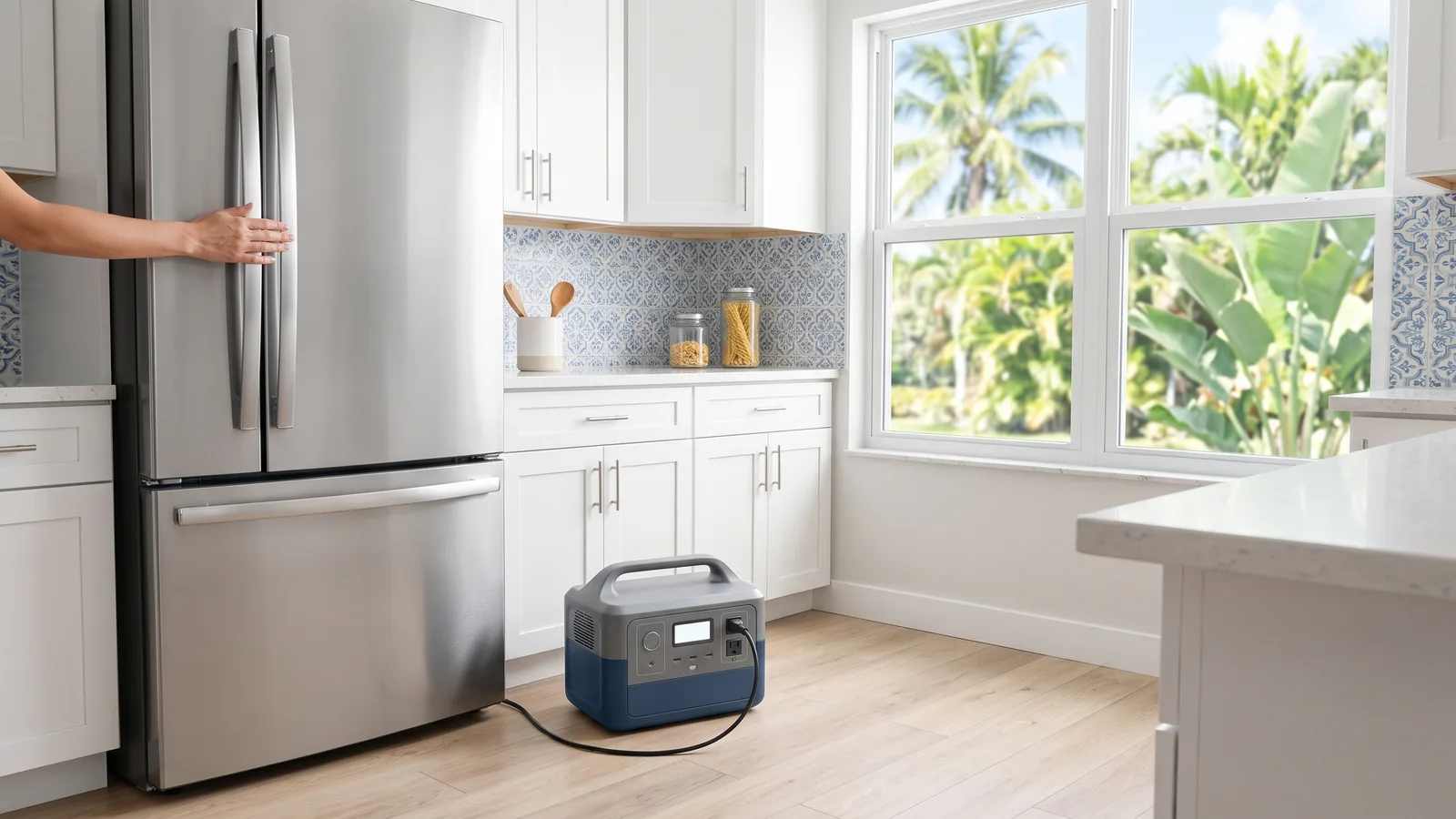
Keeping the refrigerator running is usually the top priority during a Florida power outage. Losing a fridge full of food gets expensive fast, and in hurricane season, outages regularly last several days. Here’s how to figure out exactly what size power station you need.
Quick picks
- Best for a standard fridge, multi-day outage: EcoFlow Delta 3 Max Plus
- Best budget option that still handles a fridge: Bluetti AC180
- Best for a fridge plus other appliances: Jackery HomePower 3000
- Best small unit for a mini-fridge only: Jackery Explorer 500
The two numbers that matter
Refrigerators are tricky because they don’t draw steady power. They cycle on and off, and when the compressor starts, it briefly pulls much more power than its normal running wattage — this is called the “surge” or “starting watts.”
- Running watts: what the fridge uses most of the time (typically 100-400W for a standard fridge)
- Surge watts: the brief spike when the compressor kicks on (can be 2-3x running watts, sometimes 800-1,200W)
A power station needs to handle both. If its continuous output can’t cover the surge, the compressor may fail to start or the unit may shut off.
Find your fridge’s wattage
Check the yellow EnergyGuide label on the fridge, or the specs plate inside the door. It usually lists estimated annual kWh use. To estimate running watts:
Annual kWh ÷ 365 ÷ 24 × 1000 = average watts
For example, a fridge rated at 400 kWh/year uses roughly 45W average, but that’s averaged across on/off cycles — actual running watts while the compressor is on will be higher, often 150-400W depending on size and age.
Runtime table
| Power station capacity | Fridge running watts | Estimated runtime |
|---|---|---|
| 500Wh | 150W | ~2-3 hours |
| 1,000Wh | 150W | ~5-6 hours |
| 1,500Wh | 150W | ~8-9 hours |
| 2,000Wh | 150W | ~11-13 hours |
| 3,000Wh | 150W | ~17-20 hours |
| 3,000Wh | 300W (older/larger fridge) | ~9-10 hours |
These estimates assume the compressor doesn’t run continuously, since real fridges cycle on and off rather than drawing power nonstop. Actual runtime varies with fridge age, ambient temperature, and how often the door opens.
Realistic sizing recommendation
For most Florida households wanting to keep a standard refrigerator running through a multi-day outage without recharging constantly, a 2,000-3,000Wh power station is the sweet spot. This covers roughly 12-24 hours of fridge use alone, or less if you’re also running fans, lights, and charging devices from the same unit.
If you pair the power station with a portable solar panel, you can recharge during the day and stretch the fridge indefinitely, which matters most in outages lasting more than 2-3 days — common after a major hurricane.
| Priority | Recommended setup |
|---|---|
| Fridge only, outage under 24 hrs | 1,500-2,000Wh station |
| Fridge + fans + phones, outage 2-3 days | 2,500-3,000Wh station |
| Fridge + fans + solar recharge, outage 4+ days | 3,000Wh station + 200W+ solar panel |
Tips to stretch your runtime
- Keep the fridge full. A full fridge holds cold longer than an empty one, since the mass of food acts as thermal storage. Fill empty space with water jugs if needed.
- Limit door openings. Every time the door opens, warm air rushes in and the compressor has to work harder to recover.
- Set the temperature a few degrees colder before the storm. A colder starting point buys extra time if the power station runs low.
- Use a separate cooler for drinks and snacks so the fridge door stays closed more often.
- Check the surge rating, not just the running wattage, before buying a power station, especially for older fridges with less efficient compressors.
FAQ
Will any power station run my fridge? Not necessarily. Small power stations under 1,000W of continuous output may not handle the compressor’s starting surge, especially on older or larger fridges. Check both the running watts and surge watts of your specific fridge model against the power station’s specs before relying on it.
How do I know my fridge’s exact wattage? Check the specs label inside the fridge door or on the back panel, or look up the model number on the manufacturer’s site. A basic wattage meter (like a Kill A Watt device) plugged in between the fridge and outlet gives an exact real-world reading.
Can I run a fridge and freezer at the same time on one power station? Yes, if the combined continuous output and surge needs stay under the power station’s rating. A 3,000W+ continuous output unit like the Jackery HomePower 3000 can typically handle both a fridge and a separate chest freezer.
Is it better to get one big power station or two smaller ones? One larger unit is usually simpler and more efficient for a fridge, since it avoids splitting load between two units. But two smaller units can be useful if you want to run the fridge on one and everything else (fans, phones, lights) on the other, so a single failure doesn’t take out both.