Best Portable Solar Panels for Power Stations in Florida (2026 Guide)
By Hilario Herrera · Last updated ·Research-based guide · Some links are paid links (disclosure).
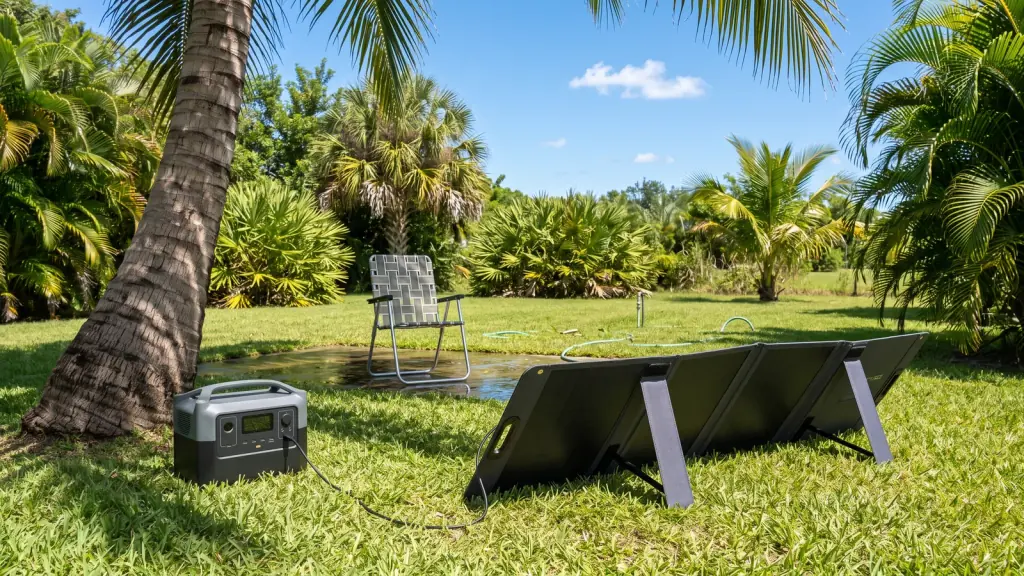
Quick picks
- Best all-around: Jackery SolarSaga 200W — durable, widely compatible, reliable in humidity
- Best high-wattage for fast charging: EcoFlow 400W Portable Solar Panel — cuts recharge time roughly in half
- Best budget option: Renogy 100W Portable Solar Panel — good for small power stations and slow top-ups
- Best rugged/waterproof: Bluetti PV200 — IP65-rated, holds up to Florida rain and humidity
Portable solar panels are the piece people underestimate when buying a power station. The battery gets all the attention, but without the right panel setup, recharging during a multi-day Florida outage can take far longer than expected — especially under the hazy, humid skies that often follow a tropical storm.
How much wattage do you actually need?
Panel wattage is a best-case number measured under ideal lab conditions (full sun, cool temperature, perfect panel angle). Real-world Florida output is typically 60-80% of the rated wattage due to humidity haze, high heat (panels lose efficiency above 77°F), and imperfect sun angles.
| Power Station Battery | Panel Wattage Needed | Approx. Full Recharge Time (Florida sun) |
|---|---|---|
| 300-500Wh | 100W | 5-7 hours |
| 1,000Wh | 200W | 6-8 hours |
| 2,000Wh | 400W | 6-8 hours |
| 3,600Wh+ | 600-800W (stacked panels) | 7-10 hours |
The takeaway: match panel wattage roughly to battery capacity if you want a full recharge within a single day of sunlight. Undersized panels still work — they just mean multi-day trickle charging, which is fine for topping off but risky if you’re relying on solar as your only recharge method during an extended outage.
What actually matters when choosing a panel
Compatibility and connector type
Most panels use MC4 connectors, but power stations often need a specific adapter (Anderson, XT60, or proprietary barrel connectors). Buying the same brand as your power station avoids adapter headaches — Jackery panels pair natively with Jackery stations, EcoFlow with EcoFlow, etc. Off-brand panels can work but check the connector and voltage range (open-circuit voltage, or Voc) against your power station’s input spec before buying.
Folding design and portability
Panels typically fold from 2 to 4 panels. More panels means more surface area and wattage but a bulkier fold. For hurricane prep where the panel lives in a closet most of the year, 2-3 fold panels in the 100-200W range balance storage size against usable output.
Weather resistance
Florida means humidity, sudden rain, and salt air near the coast. Look for an IP65 rating or better, and kickstands or grommets that let you angle the panel without it blowing over in gusty pre-storm winds. ETFE-laminated panels (rather than PET) resist yellowing and hold efficiency longer in intense UV.
Efficiency (monocrystalline vs. polycrystalline)
Nearly every portable panel sold today is monocrystalline, which converts 20-23% of sunlight to electricity versus roughly 15-17% for older polycrystalline designs. If a panel’s efficiency isn’t listed, that’s a red flag — reputable brands always disclose it.
Positioning for maximum output in Florida
- Angle toward the sun, not flat on the ground. A panel angled roughly toward the sun’s position can produce 20-30% more power than one laid flat.
- Avoid partial shade. Even one corner shaded by a tree branch or cloud edge can drop a panel’s output disproportionately because of how solar cells are wired in series.
- Reposition every few hours. The sun moves fast enough in Florida’s latitude that repositioning a panel 2-3 times a day meaningfully improves total daily charge versus leaving it static.
- Watch the heat. Panels lose roughly 0.3-0.5% efficiency per degree above 77°F (25°C) — on Florida’s hottest days, propping the panel with airflow underneath (rather than flush on hot concrete) helps.
Stacking multiple panels
Most power stations support 2 panels in parallel via a Y-adapter or dual solar input ports, doubling your charge rate. If you’re serious about running a power station through a week-long outage, buying two 100-200W panels rather than one large 400W panel adds redundancy — if one panel is damaged by storm debris or drops in a puddle, you still have partial charging capacity.
FAQ
Can I use a portable solar panel to charge while running appliances? Yes, most power stations support pass-through charging, meaning you can draw power for a fridge or fan while the panel recharges the battery — though total charging is slower when the station is under load.
Do portable solar panels work through glass or on a covered porch? Panels lose significant output through glass (glass blocks a portion of usable light wavelengths) and in shade — for meaningful charging, they need direct outdoor exposure.
Are generic/off-brand panels worth buying to save money? They can work if voltage and connector specs match, but many owner reviews cite generic panels underperforming their rated wattage or failing after a season of humidity exposure. Sticking with the power station manufacturer’s own panel, or a well-reviewed brand like Renogy or Bluetti, reduces that risk.
How many panels do I need for a whole house battery backup? Portable panels are not a substitute for a fixed rooftop solar array. If you’re trying to offset whole-home usage rather than just recharge a portable power station, you need a permitted rooftop or ground-mount solar installation sized by a licensed installer.
Can I leave solar panels out in the rain? IP65-or-better rated panels handle rain fine, but avoid submerging them or leaving connectors exposed to standing water — disconnect and dry connectors before reconnecting to a power station.