Solar Power Options for Florida Apartment Renters and Condo Owners
By Hilario Herrera · Last updated ·Research-based guide · Some links are paid links (disclosure).
Quick picks
- Best for balcony/patio use: Jackery Explorer 300 + SolarSaga 100W — compact, no permits, portable enough to store in a closet
- Best for a hurricane go-bag: Anker 521 PowerHouse — small, light, covers phones and a fan
- Best mid-size for a small apartment: EcoFlow River 3 Plus — runs a mini fridge or CPAP for a night or two
- Best window-mount solar charger: BigBlue 28W Foldable Panel — clips to a balcony rail, good for phone/USB charging only
Most solar content assumes you own a roof. Renters and condo owners in Florida — a huge share of the state’s population, especially in Miami-Dade, Broward, and Orlando metros — don’t have that option, but that doesn’t mean solar is off the table. It just means thinking in terms of portable power stations and small panels rather than a rooftop system.
Why rooftop solar usually isn’t available to renters
Florida law (the Florida Solar Rights Act) protects a property owner’s right to install solar, but it does not give tenants the right to install panels on a landlord’s roof, and condo associations can restrict where panels go via their governing documents, subject to some limits on outright bans for owner-occupied units. Bottom line: if you rent or live in a condo, assume you need your landlord’s or HOA’s written permission before mounting anything permanent — and in nearly all rental cases, that permission won’t be granted.
What actually works for apartment living
Portable power stations
This is the realistic solar-adjacent option for renters. A power station (battery + inverter) charges from a wall outlet in normal times and from a portable panel during outages. It requires no installation, no permission, and moves with you if you relocate. For apartment living, look at:
- 300-600Wh units for essentials — phone, router, lamp, small fan — ideal for a studio or 1-bedroom
- 1,000Wh+ units if you want to run a mini fridge or CPAP overnight during an outage
Balcony or patio solar panels
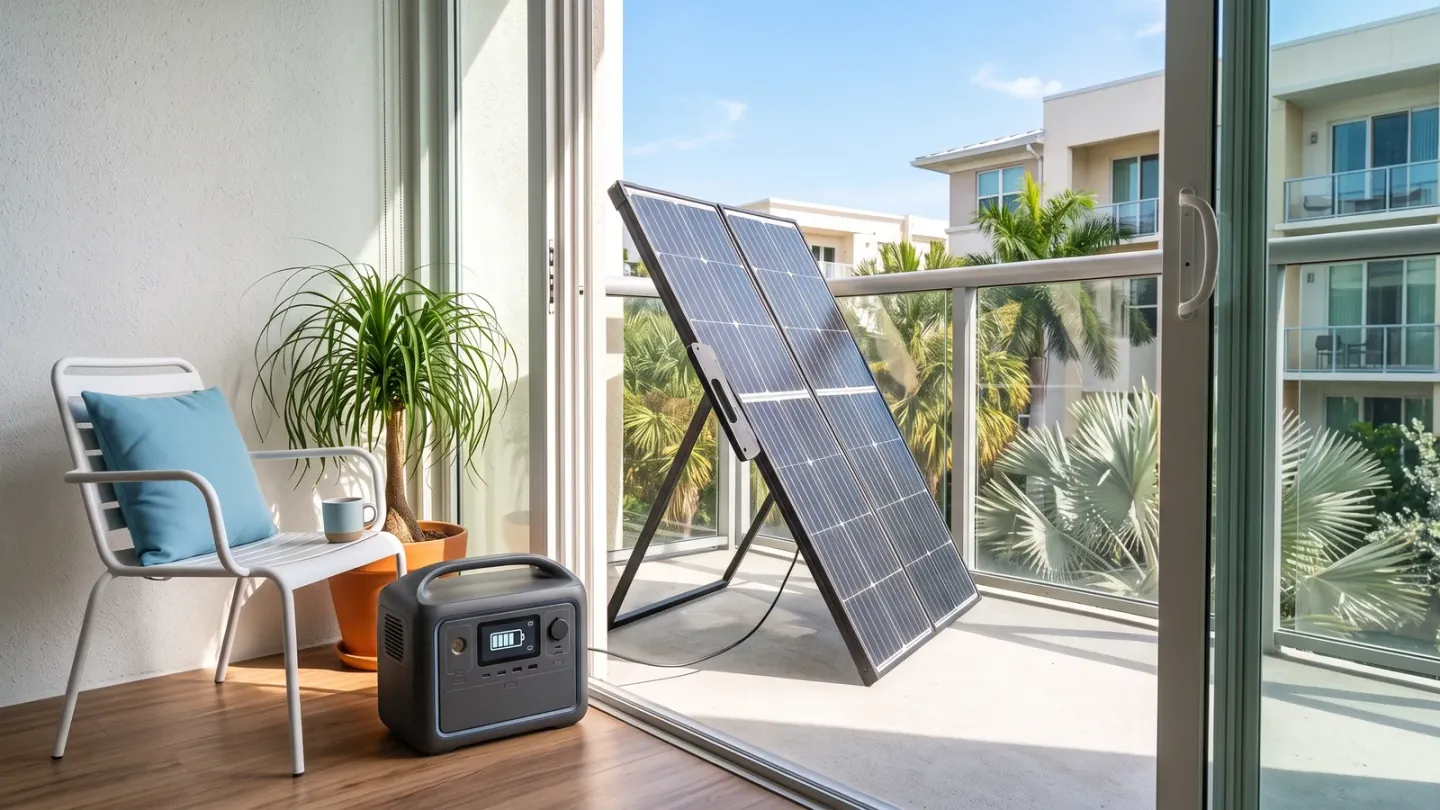
A foldable 100-200W panel propped against a balcony railing or patio chair during daylight hours can meaningfully recharge a power station without any mounting or drilling. Check your lease and HOA rules — most allow temporary, non-mounted equipment on a private balcony or patio, but some buildings restrict what’s visible from the street or common areas. When in doubt, ask your property manager in writing.
Window and rail-clip solar chargers
Small 20-30W panels with suction cups or rail clips are more of a phone/USB trickle charger than a real power source, but they’re useful for people in units with no usable outdoor space at all — a north-facing high-rise balcony, for instance.
What to check before buying
| Question | Why it matters |
|---|---|
| Does my lease prohibit exterior equipment? | Many leases restrict anything visible from outside the unit, including on balconies |
| Does my HOA/condo board require design review? | Some Florida condo docs require pre-approval even for portable/temporary equipment |
| Do I have outdoor access at all? | Interior units with no balcony may need to rely on window charging or grid-only charging |
| What’s my realistic power need? | A studio apartment doesn’t need the same battery capacity as a house running a fridge and well pump |
| Storage space? | Panels fold flat but still need a closet spot; factor this into sizing |
Building a renter-friendly hurricane kit around a power station
- Keep it charged year-round, not just June through November — Florida can see off-season storms and grid issues aren’t limited to hurricane season.
- Pair with a portable panel so you’re not solely dependent on wall power if an outage stretches past the battery’s charge.
- Prioritize loads: phone, medical devices, and a fan or small cooler matter far more in an apartment than trying to run a full-size refrigerator off a small unit.
- Check building policy on generators — most Florida apartment buildings ban gas generators outright due to fire code and carbon monoxide risk in shared structures, which makes battery power stations the only legal backup option in many buildings.
- Evacuate when told to. No power station replaces evacuation orders in a mandatory zone — treat battery backup as bridging power for pre- and post-storm periods, not a reason to shelter through a major hurricane in an unsafe building.
FAQ
Can my landlord ban me from having a portable power station or solar panel? Generally no — a battery power station and a small unmounted panel are personal property, not a fixture requiring landlord approval, similar to owning a space heater. However, leases can restrict where you use equipment (e.g., balcony rules, fire code on charging near exits), so read your lease.
Is community solar available in Florida? Some Florida utilities (including a few municipal providers) offer community solar subscription programs where you pay for a share of a solar farm’s output as a bill credit, without installing anything. Availability varies significantly by utility — check with your electric provider directly since programs open and close over time.
Will a small solar setup lower my electric bill? Not meaningfully. Portable panels and power stations are sized for backup power and off-grid convenience, not for offsetting a full apartment’s grid electricity use. Real bill savings require a grid-tied rooftop or community solar arrangement, neither of which is typically available to renters.
What size power station should I buy for a 1-bedroom apartment? For essentials only (phone, router, a fan, some lighting), 500-1,000Wh is usually enough for a multi-day outage with careful use. If you have medical equipment or want to keep a small fridge running, size up to 1,000-1,500Wh.
Can I charge a power station using my apartment’s outdoor common areas? Only with explicit permission — placing equipment in shared common areas (pool deck, courtyard) without authorization can violate your lease or HOA rules, and there’s also a theft risk. Stick to your own balcony, patio, or unit.